Cross-disciplinary Aesthetic Education x Social-Emotional Learning Navigation Card
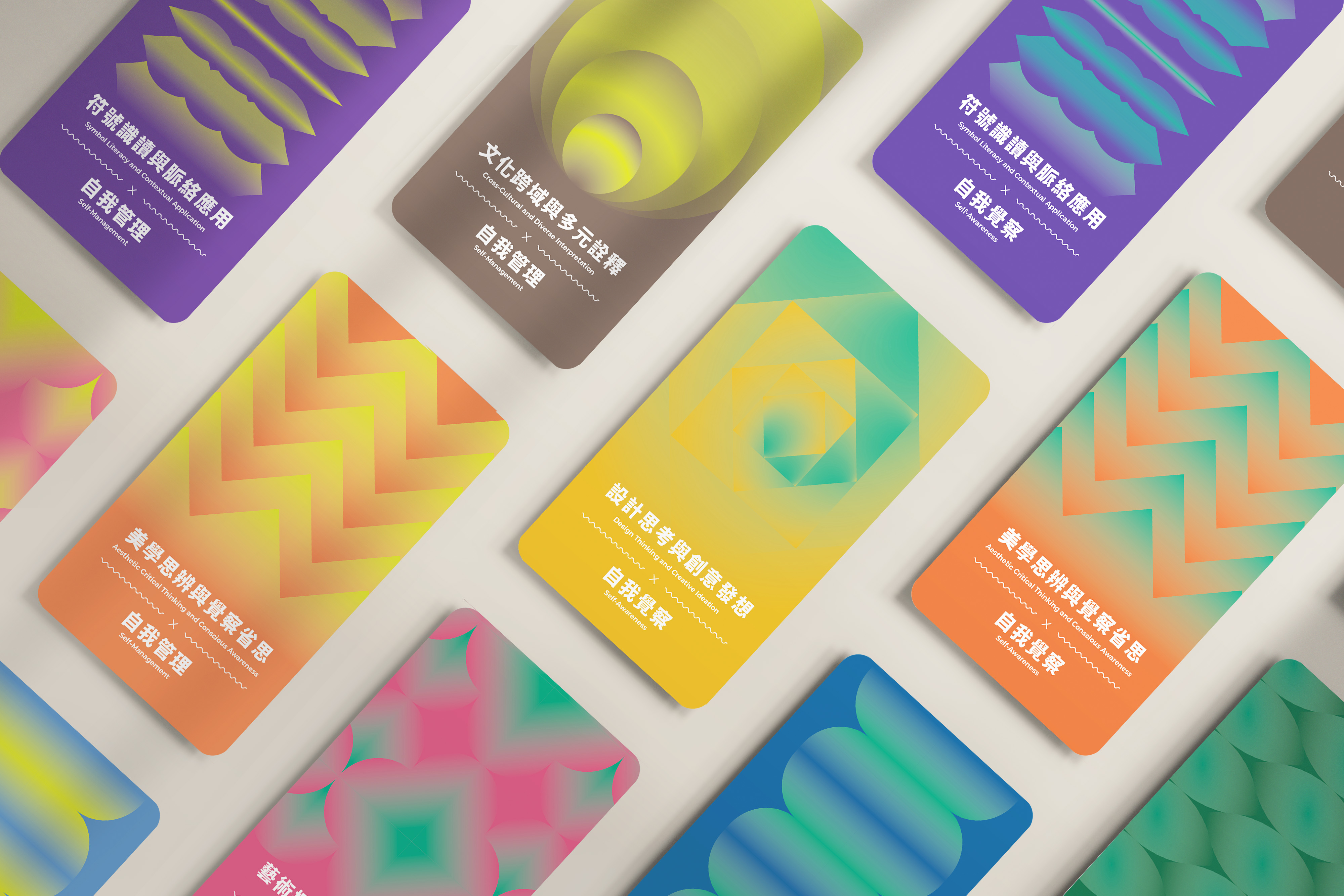
The "Interdisciplinary Aesthetic Education x Social-Emotional Learning Navigation Card" originates from the Ministry of Education's "Interdisciplinary Aesthetic Education Excellence Leading Project." Centered on art, it combines interdisciplinary thinking with social-emotional education. Through two-way questioning of interdisciplinary aesthetic literacy and social-emotional learning literacy, it guides learners to engage in dialogue and reflection within artistic activities and life situations, cultivating empathy, emotional regulation, and collaborative abilities. It serves as a teaching guide tool connecting interdisciplinary aesthetic and social-emotional learning.
Why was the "Interdisciplinary Aesthetic Education x Social-Emotional Learning Navigation Card" created?
- Interdisciplinary aesthetic education and socio-emotional learning have a high degree of intrinsic consistency.
Artistic activities and products are themselves carriers of the creator's emotions and experiences. When promoting social emotional learning, which emphasizes concepts such as "awareness and understanding of emotions," "empathy and interpersonal interaction," and "coping with stress, conflict, and choices," art education can be used to guide learners to explore themselves and think from different perspectives through its openness and inclusiveness in emotional expression. This makes interdisciplinary aesthetic education an ideal practice field for social emotional learning.
- The diverse applications of navigation cards provide educators with opportunities to practice "two-way literacy."
Navigation cards can be flexibly applied to artistic and interdisciplinary contexts, guiding learners to engage in empathy, collaboration, and emotional regulation and reflection. They support the deepening of aesthetic learning with social-emotional learning literacy. Through corresponding two-way literacy questioning and thinking, the cards become a navigation tool for two literacy systems, making interdisciplinary classroom learning more diversified.
How to use《Cross-field aesthetic education1 TP3Tbcx1T P3Te51TP3 Ta1social emotional learning Navigation card》
- Guide and deepen artistic experience and socio-emotional learning through questions.
The navigation cards feature an emphasis on interdisciplinary learning centered on "art," connecting art, humanities, technology, and real-life situations to naturally integrate socio-emotional learning. When used, questions from different perspectives guide learners to think, converse, and reflect within artistic experiences and real-world contexts, cultivating emotional awareness, self-expression, and psychological resilience.
- Interdisciplinary aesthetic literacy and socio-emotional literacy are learned and enhanced in a two-way manner.
The navigation cards combine interdisciplinary aesthetic literacy with socio-emotional literacy through two-way questioning. Through guidance, discussion, and sharing, students learn to be self-aware, listen to others, and respect differences, developing creative thinking, interdisciplinary integration, and problem-solving skills. They also provide structured teaching modules and flexible application methods to help incorporate socio-emotional learning exploration into the process of art activities, developing an integrated curriculum that fosters two-way learning.
Supplementary teaching materials:
《Cross-field aesthetic education1 TP3Tbcx1T P3Te51TP3 Ta1social emotional learning Two-way navigation map》
The "Interdisciplinary Aesthetic Education x Social-Emotional Learning Two-Way Navigation Map" uses the seven interdisciplinary aesthetic qualities as a horizontal classification and the five SEL qualities as a vertical framework. Through cross-comparison, it clearly marks the awareness points and thinking directions that can be developed in each learning dimension.
When using it, teachers or facilitators can select one of the competencies according to the course objectives, locate the relevant position according to the table, and use the corresponding navigation cards to guide questions, design course activities, or reflect on learning.
Navigation cards serve as a trigger for perception and discussion, while navigation charts provide an overall framework and advanced extensions, helping users establish a clear connection between specific operations and theoretical understanding, enabling a visual, traceable, and in-depth teaching path for cross-disciplinary aesthetics and SEL bidirectional learning.
"Interdisciplinary Aesthetic Education x Social-Emotional Learning Self-Exploration Compass" & "Interdisciplinary Aesthetic Education x Social-Emotional Learning Self-Exploration Coordinate Map"
The "Interdisciplinary Aesthetic Education x Social-Emotional Learning Self-Exploration Compass" and the "Interdisciplinary Aesthetic Education x Social-Emotional Learning Self-Exploration Coordinate Map" are self-guided learning positioning tools for the "Interdisciplinary Aesthetic Education x Social-Emotional Learning Navigation Card". They can help users quickly compare observable behaviors and performances under different learning dimensions, and conduct awareness, self-positioning, and learning reflection in the process of interdisciplinary aesthetic literacy and social-emotional learning.
When using this tool, teachers or facilitators can locate relevant competencies in the table based on the course content and activity objectives, serving as a basis for observation, recording, and feedback. The items listed in the compass focus on identifiable behavioral descriptions during the learning process, rather than as a reference for outcome scoring, making it suitable for formative assessment, instructional adjustments, or review of the learning process. When used in conjunction with navigation cards and maps, it can help users establish a clear and consistent framework for assessment and reflection, from perceptual experience and behavioral performance to competency development.
References:
The Collaborative for Academic, Social, and Emotional Learning (CASEL), (2020), "The CASEL 5 Framework".
Washington Office of Superintendent of Public Instruction (OSPI), (2020), Washington state K-12 social emotional learning standards and benchmarks.
Huang, Chi-Hui (2024), "The Practice and Challenges of Integrating Social-Emotional Learning into Junior High School Arts: The Construction of Teacher Perspectives and Teaching Indicators." *Art Education Research*, No. 48 (December 2024), pp. 1-37.
Textbook download