Textbook Resources [Worksheets and Assessments]
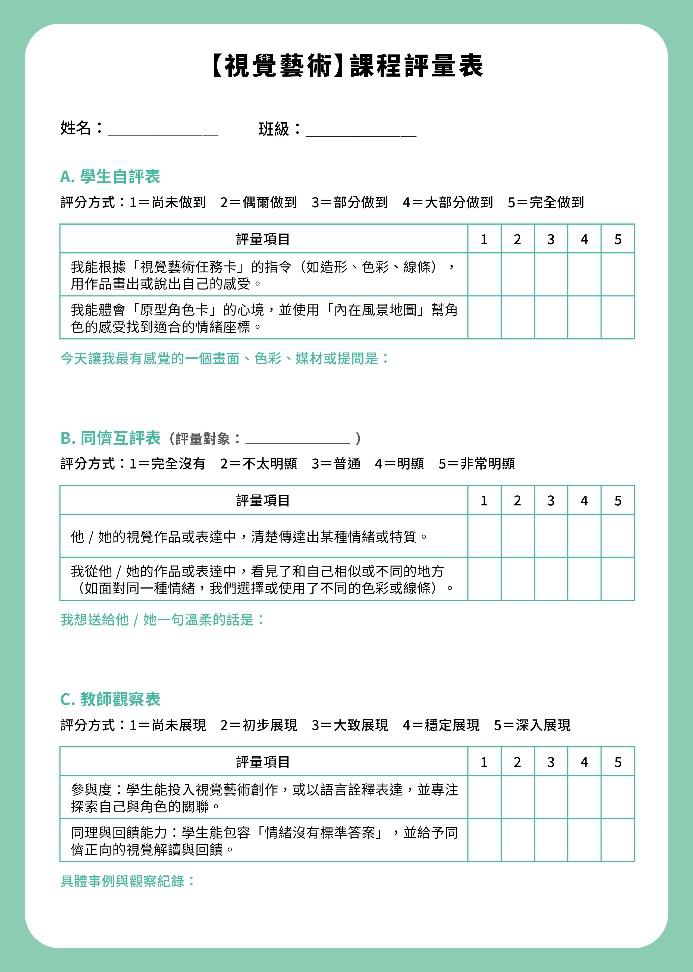
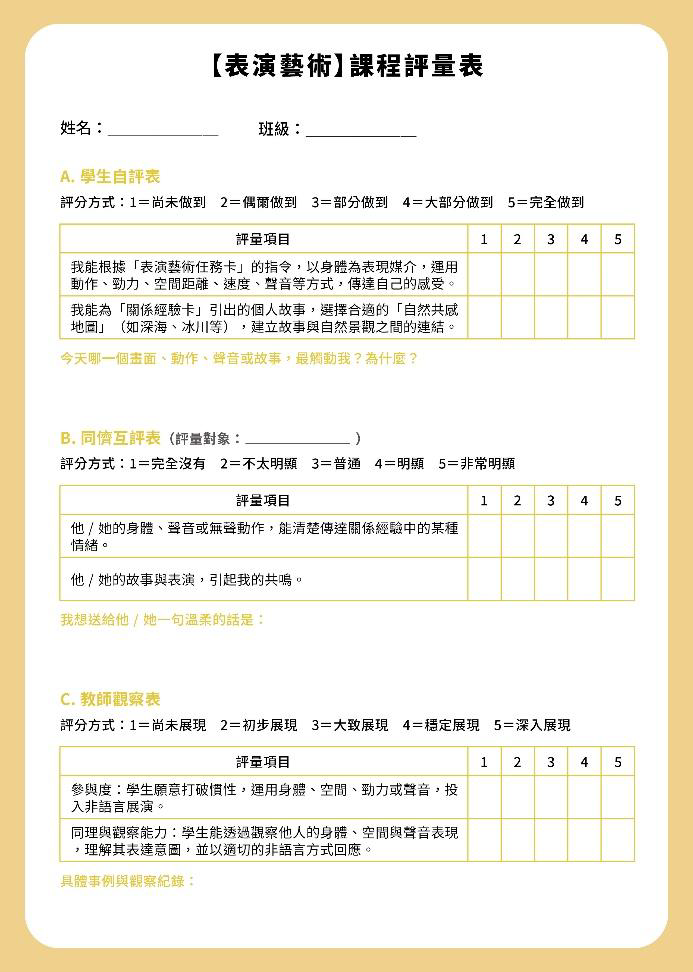
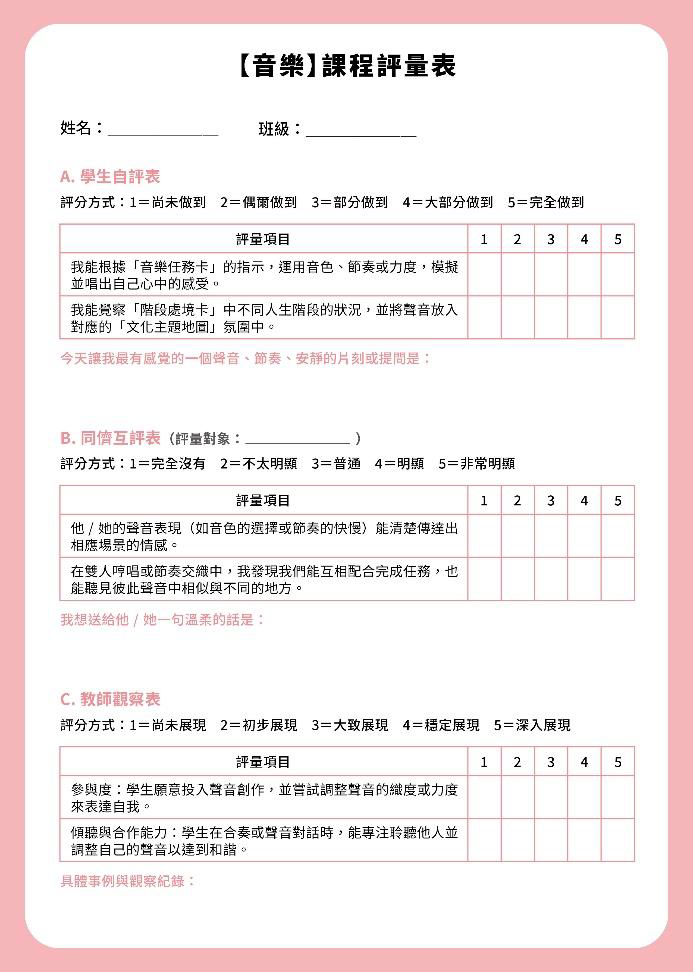
The Multi-Treasure Box after-class feedback worksheet is divided into two series: "Cards" and "Expansion Kits." They are designed for four different art disciplines: Visual Arts, Music, Performing Arts, and Interdisciplinary Aesthetics. They are aligned with the five dimensions of socio-emotional learning: artistic perception, self-awareness, self-management, social awareness, interpersonal skills, and responsible decision-making. They guide students to start from their current sensory experiences and gradually organize their awareness of emotions and interpersonal interactions. They are suitable as an immediate feedback tool after each class.
The expansion kit series is paired with advanced teaching materials (prototype character cards × inner landscape map, stage situation cards × cultural theme map, relationship experience cards × natural empathy map), which guide students from artistic experience to self-narrative and life transfer through five levels: "discovery, emotion and awareness, experience and life, relationship and understanding, inspiration and action". This allows students to not only respond to classroom content, but also to transform the feelings and images in the classroom into reflections on their own experience and future actions.
Post-class feedback worksheet
Together, the two series form a progressive feedback mechanism from "feeling → understanding → action," allowing each art experience to extend into daily life. The learning sheet is presented below:


Card Game Post-Lesson Feedback Sheet


Card Game Post-Lesson Feedback Sheet


Expansion Kit Post-Class Feedback Worksheet


Expansion Kit Post-Class Feedback Worksheet
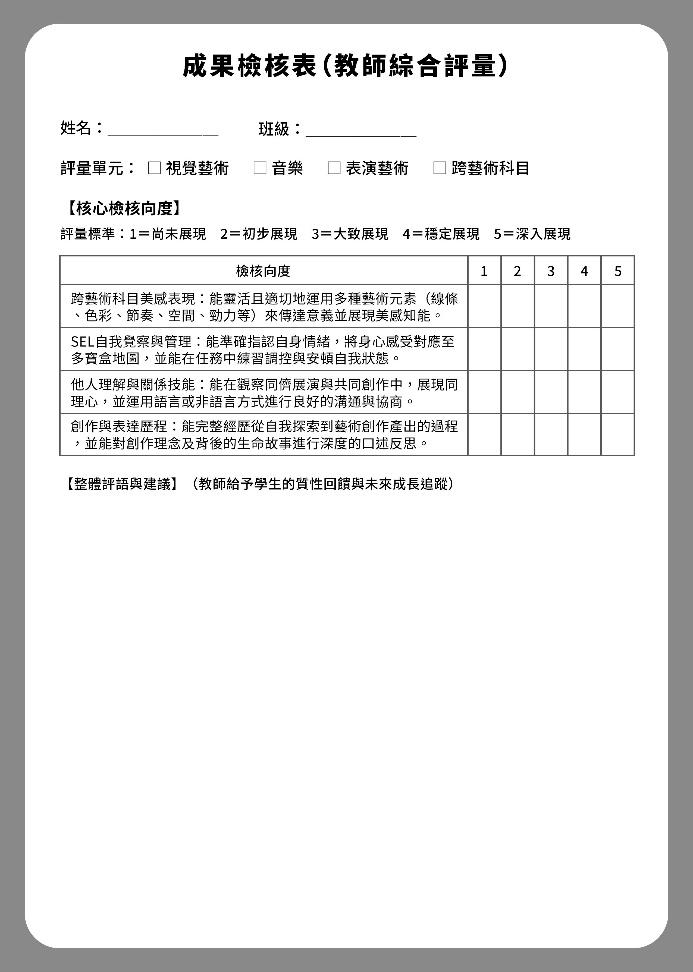
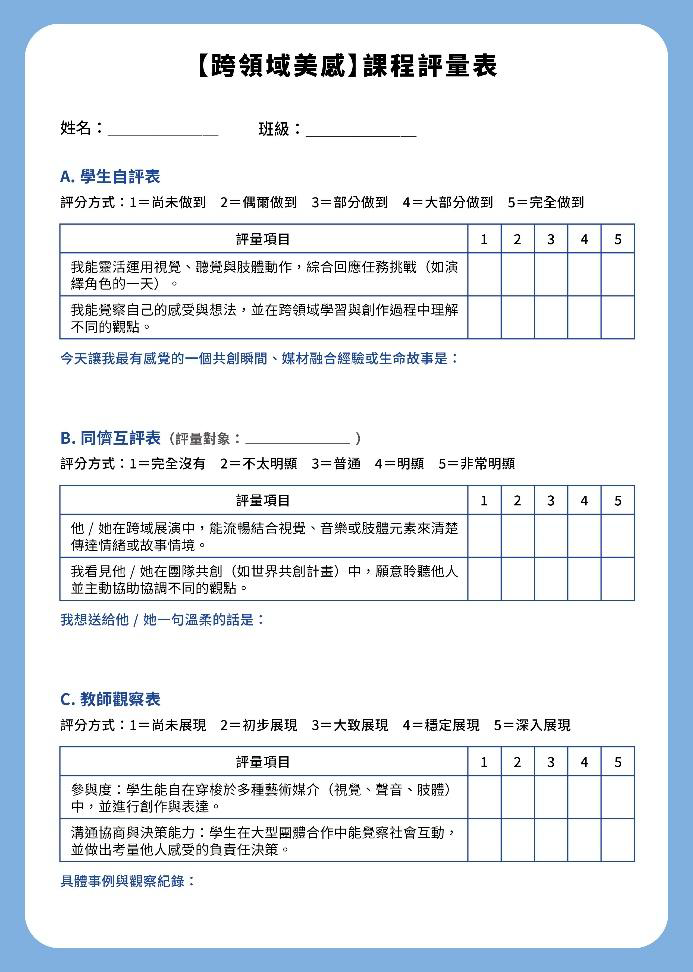
Multivariate assessment design
Interdisciplinary aesthetic and social-emotional learning (SEL) curricula focus not on the presentation of knowledge, techniques, or works, but on students' transformations in emotions, attitudes, values, interpersonal interactions, creativity, and self-awareness. These transformations are often process-oriented, context-dependent, and subjective, making them difficult to fully understand through a single assessment tool. Therefore, the assessment of interdisciplinary aesthetic and SEL should shift from evaluating "learning outcomes" to evaluating "learning processes," adopting a multiple assessment approach to collect data on students' diverse performances in different contexts. Teachers should emphasize students' participation and growth trajectory in the processes of inquiry, creation, collaboration, expression, and reflection. For example, through student self-assessment, peer assessment, teacher observation records, learning process files, work analysis, reflective notes, interviews, or performances, teachers can gain a multi-faceted understanding of whether students have shown changes or improvements in their abilities in emotion recognition, empathy, collaborative communication, perspective shifting, aesthetic expression, and self-identity.
The following are examples of assessment methods that can be used.